
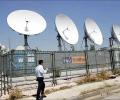
At least half a dozen foreign satellite firms with over 100 C-band transponders have initiated their talks with domestic media firms which are interested in launching headend-in-the-sky cable distribution platform.
In a sure sign that recent changes in the business of cricket are here to stay, Saturday's India-Pakistan one-day final of a tri-series failed to attract television viewers to the extent recent Indian Premier League matches did.
Sports broadcaster ESPN Star Sports and direct-to-home operator Tata Sky may soon get entangled in a legal battle as Tata Sky has dropped ESPN, Star Sports and Star Cricket from its basic package offerings. The move, according to ESPN's lawyers, may go against a recent Delhi high court order that restrains Tata Sky to do so, but the second largest DTH operator maintains that it is operating within the permissible rules.
This means the cable companies engaged in last-mile distribution of TV channels will qualify for the existing 49 per cent FDI limit, while operators of DTH, HITS, IPTV and multi-system operators will be able to bring in up to 74 per cent FDI, a limit proposed by broadcast regulator Telecom Regulatory Authority of India.
This move will make Dish TV, an Essel Group company, the first DTH operator to have installed their DTH services in consumer homes, cars, buses, aircraft, cruise liners and on trains. "Dish everywhere is our motto. We aim to provide our DTH services across all platforms, whether moving, flying or stationary," a senior Dish TV executive said. This move is likely to help the company market its services to the potential consumers more effectively.
The regulator may ask broadcasters to abide by the tribunal's pricing formula.
The govt was supposed to issue the CAS expansion notification by April 30. The expansion of the conditional access system beyond southern parts of Delhi, Mumbai and Kolkata, and subsequently to 55 more cities, may be further delayed with the Ministry of Information and Broadcasting seeking a detailed report from the cable industry on tackling piracy of pay channels after the system comes into effect.
The price-war has begun in the direct-to-home market with the country's largest DTH company Dish TV with over three million subscribers getting ready to offer its connection virtually free. Any consumer who wants to buy a Dish TV connection will not have to pay for the set-top box, the hardware essential to access DTH services, which normally costs Rs 2,500.
According to the ratings data released by the online media ratings agency Audience Measurement and Analytics Ltd (aMap) for April 25-27, SetMax not only got higher average viewership ratings than Star Plus between 8 pm and 9 pm, when the quiz show aired, but the average time spent on SetMax (40 minutes) was double what viewers spent on Star Plus.
In order to take on the competition posed by the direct-to-home (DTH) operators, large cable distribution companies will soon bring in their own digital-quality cable television offerings in select cities at competitive fees and offer quality service support.
Dish TV and Tata Sky, the country's two direct-to-home (DTH) companies, are expected to post losses in excess of Rs 1,400 crore for 2007-08 in their quest to expand the market by offering set-top boxes at subsidised rates. The companies have over five million subscriber homes across the country collectively.
The Indian Broadcasting Foundation (IBF), the apex body of broadcasters, and Advertising Agencies Association of India (AAAI), a body that represents over 70 per cent of the television advertisers have decided to tigten their rules. All advertisers will now have to make payments within 60 days of airing the television commercials, failing which there will be a financial penalty and a possible boycott on all television networks. This 2-year agreement is valid till March 2010.
This has been agreed between the Indian Broadcasting Foundation, an apex body of broadcasters, and the Advertising Agencies Association of India, which represents over 70 per cent of TV advertisers in India and has over 120 members represented by leading advertising agencies and broadcasters.
This means that if Star TV's bouquet of 14 channels is priced at Rs 88 in non-CAS areas (70 million cable TV homes), it can charge only Rs 44 or less from existing DTH operators like Tata Sky, Dish TV and new entrants like Big TV, Bharti and Sun Direct. But all broadcasters are charging more from DTH companies than from non-CAS cable homes.
Discovery Networks India Executive Vice-President and MD Deepak Shourie said that the DTH platform has been able to quickly penetrate cable homes by reaching out to 5 million subscribers within a couple of years. Discovery Communications globally offers channels such as Discovery Health, Military Channel, TLC, Science Channel, Investigation Discovery among others. The group might bring in one of these channels for the DTH platform, sources indicated.
The process may begin as early as November this year if the cable industry's plan, submitted to the ministry of information and broadcasting, is accepted. CAS has been implemented only in parts of these three cities. As the technology enables consumers to choose channels, the expansion will bring down the average monthly cable bill of about 7.2 million consumers in the non-CAS areas in these cities by almost half to Rs 150-Rs 200.
Trai has announced that it may fix prices of pay channels on the direct-to-home (DTH) platform in line with the Rs 5 per channel cap on conditional access system (CAS) services in Delhi, Mumbai and Kolkata. This move will lower the fees but hit the income of broadcasters from DTH companies. However, new DTH entrants will benefit from the move as their cost of content will decrease. For the 2 existing DTH companies, Dish TV & Tata Sky, the current rates are likely to continue.
According to sources in the Bureau of Indian Standards, the onus of providing the transcoders will be on new DTH players. The BIS has also been asked to submit a detailed report on interoperability of DTH set-top boxes to the I &B ministry. The set-top boxes being used to receive services from the existing players, Dish TV and Tata Sky, are not compatible with the new-technology services that will be provided by DTH firms.
Sony's Set Max - the host broadcaster of the Indian Premier League (IPL) has its eyes on the ad revenues that the Twenty20 format cricket tournament is likely to produce. The 7 pm-10 pm TV slot attracts ad revenue worth over Rs 2,000 cr between various entertainment channels. On Set Max, the advertisers will have about 35 hours of advertising spots for the first IPL tournament with fixed on-air sponsors. Set Max has three associate sponsors in Nokia, Hero Honda and Coca Cola.
As the CAS technology gives the consumers a choice in watching television channels with assured quality of service and affordable pricing, a nationwide CAS roll-out will bring down the average monthly cable bills of the consumers by almost half to about Rs 150-Rs 200.
